
Powerful Floor Standing AC for Shops, Offices and Large Spaces
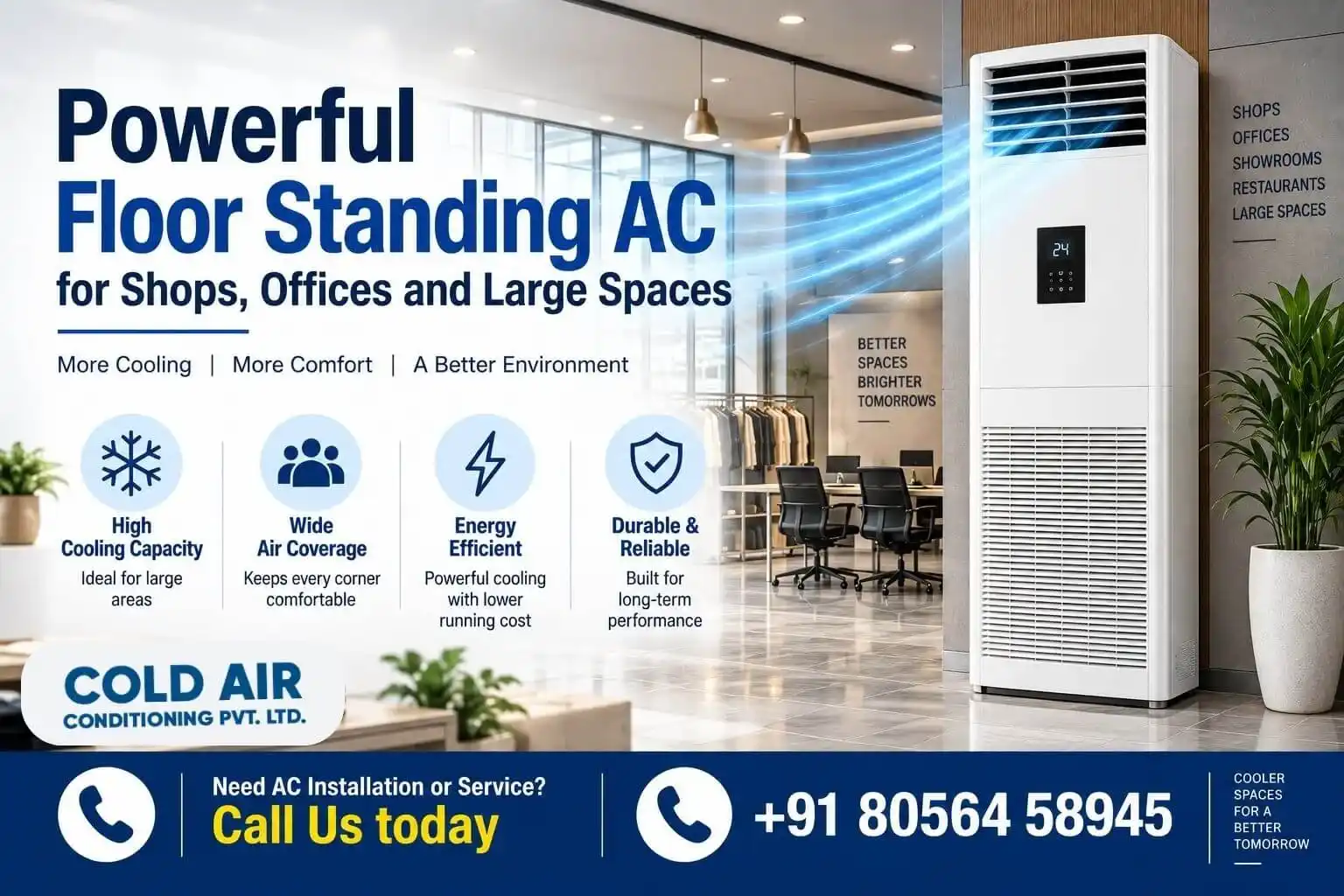
Cooling a commercial space is different from cooling a home. Shops, offices, showrooms and halls often have larger floor areas, more people moving in and out, equipment that produces heat and doors that open frequently. A small residential AC may not provide the cooling capacity or airflow needed for such spaces.
A Commercial Floor Standing AC is designed for situations where strong cooling and wider air distribution are important. Its floor-mounted design also makes it a practical choice when wall mounting is difficult or when a business needs a high-capacity AC without major changes to the existing wall structure.
Why Choose a Floor Standing AC for Commercial Spaces?
A floor standing AC is installed at floor level and generally has a larger indoor unit than a typical wall-mounted split AC. This design allows it to deliver a strong volume of air into the room.
For commercial areas, this can be useful because cooling needs are often higher than in a standard residential room. For example, a busy retail shop may have its entrance opening throughout the day, while a showroom with glass frontage can receive additional heat from sunlight. Offices may have computers, lighting and several employees adding to the heat inside the space.
This is why the AC should be selected based on how the commercial space is actually used, not simply by choosing a higher-capacity model.
Floor Standing AC for Shops
Shops often have open entrances, glass fronts and regular movement of customers. Display lighting and electrical equipment can add even more heat during business hours. These conditions can make it harder to maintain an even indoor temperature.
A Floor Standing AC for shops can provide strong airflow across the sales area and help cool a larger portion of the space. Its floor-mounted position can also be useful where wall space is occupied by shelves, displays, signs or other fixtures.
Before selecting a model, consider the shop's floor area, ceiling height, number of entrances, glass exposure and heat produced by lighting or equipment.
Floor Standing AC for Offices
Offices need a comfortable working environment throughout the day. In a larger office, cooling one small section does not always provide an even temperature across the entire workspace.
A Floor Standing AC for offices can be considered for open-plan offices, meeting areas, reception spaces and other larger rooms. Strong airflow can help distribute cool air over a wider area, while the floor-standing design avoids using valuable wall space. For offices divided into several enclosed rooms, separate units or another commercial air-conditioning system may provide better temperature control.
AC for Large Commercial Spaces
Large halls, showrooms, retail spaces, restaurants and other commercial areas often require more cooling than a standard residential AC can provide.
An AC for large commercial spaces should be selected after considering factors such as:
- • Total floor area
- • Ceiling height
- • Number of occupants
- • Number of doors and windows
- • Heat from lighting and electrical equipment
- • Sun exposure and glass frontage
- • Building insulation
- • Expected operating hours
Two commercial spaces with similar floor areas can still require different cooling capacities. For example, a closed office and a busy showroom with large glass windows experience very different heat loads.
A proper site assessment can therefore provide clearer insights than selecting an AC based only on square footage.
Cooling Capacity and Space Coverage
Cooling capacity is one of the first things to consider when choosing a commercial AC. If the capacity is too low, the system may struggle to bring the room to the desired temperature, particularly during hotter periods or busy business hours.
Choosing a much larger unit is not automatically better either. The aim is to match the cooling capacity with the actual conditions inside the space.
Room shape also affects coverage. A wide-open showroom, a long retail floor and a hall divided by partitions may each distribute cooled air differently. Capacity and space coverage therefore need to be considered together before deciding on a system.
Airflow and Air Distribution
Cooling capacity is only one part of commercial air conditioning. Airflow is equally important when the room is large. A floor standing AC can be useful where strong air delivery is needed from a single floor-level position. The airflow direction and throw should be considered based on the shape of the room and the position of employees, customers or displays.
For example, tall shelving in a retail store or partitions in an office can interrupt airflow. In a long showroom, placing a powerful unit at one end without considering air distribution may leave some sections less comfortable than others.
Looking at these practical obstacles before installation helps determine where the indoor unit should be positioned for better air movement.
Installation Advantages
One of the main advantages of a floor standing AC is its installation position. Since the indoor unit sits on the floor, there is less dependence on available wall space compared with a conventional wall-mounted unit.
Floor standing units can also be considered during renovation projects where businesses want to add commercial cooling without making major changes to the interior. The outdoor unit location, refrigerant piping, electrical supply, drainage and clearance around the indoor unit still need proper planning. Professional installation is important because poor positioning or installation can affect the performance of even a correctly sized AC.
Energy Efficiency and Operating Costs
For a commercial business, air-conditioning costs can form a significant part of regular electricity consumption. Since commercial ACs may operate for many hours each day, energy efficiency should be considered before purchasing.
Look at the model's energy-related specifications, operating conditions and expected daily usage rather than focusing only on the initial purchase price.
For a shop or office that depends on its AC throughout the working day, regular cleaning and scheduled servicing can also help maintain consistent performance.
What Should You Check Before Choosing a Floor Standing AC?
When comparing a powerful commercial AC, advertised capacity should not be the only deciding factor.
Check whether the capacity is suitable for the actual heat load of the space and whether the airflow can reach the areas that need cooling. Think about how many hours the system will operate each day and where the indoor and outdoor units can practically be installed.
Filters and serviceable components should remain reasonably accessible, particularly in commercial environments where regular servicing is important.
If the required capacity is unclear, a site assessment is useful. An air-conditioning professional can look at the room dimensions, ceiling height, glass exposure, occupancy, equipment and layout before recommending a suitable capacity and system type.
Is a Floor Standing AC Right for Your Business?
A floor standing AC can be a practical option for businesses that need strong cooling and airflow in larger rooms. Shops, offices, showrooms, halls and similar commercial spaces can consider this type of system when floor-level installation suits the layout.
It may not be the best choice for every commercial building. A property with several separate rooms, unusual layouts or different cooling requirements across individual areas may need another type of commercial air-conditioning arrangement.
This is why choosing the system after looking at the actual site is more useful than deciding only from tonnage, price or appearance
Explore Commercial Floor Standing AC Options
If you are planning air conditioning for a shop, office, showroom or large commercial area, explore the available Commercial Floor Standing AC options based on your space and cooling requirements.
Cold Air Conditioning can assist with selecting a suitable commercial cooling system based on the actual conditions of your property. As a Daikin Authorized Channel Partner, the team can provide product guidance, site assessment and installation support for commercial air-conditioning requirements.
Instead of deciding only from capacity or price, you can discuss the size and layout of your commercial space with Cold Air Conditioning to understand which AC configuration is more suitable.
Frequently Asked Questions
1. Is a floor standing AC suitable for a showroom?
Yes. It can be suitable for showrooms that need strong airflow across a
larger open area, particularly where wall space is limited.
2. How do I choose AC capacity for a large
shop?
Consider the shop's floor area, ceiling height, customer
movement, entrances, windows, lighting and heat-producing equipment. A site
assessment can give a more accurate capacity requirement than floor area alone.
3. Can a floor standing AC cool a large open space?
It can cool larger open areas when the capacity and airflow are
suitable for the space. Very large or unusually shaped areas may require more than
one unit or another commercial cooling arrangement.
4. Does a floor standing AC require an outdoor unit?
Most floor standing split AC systems use an outdoor unit connected to
the indoor unit. Installation requirements depend on the specific model and system
configuration.
5. Is one large AC better than multiple AC units for an
office?
Not necessarily. One unit may work for a large open area,
while an office divided into several rooms may benefit from multiple units or
another commercial AC system.